

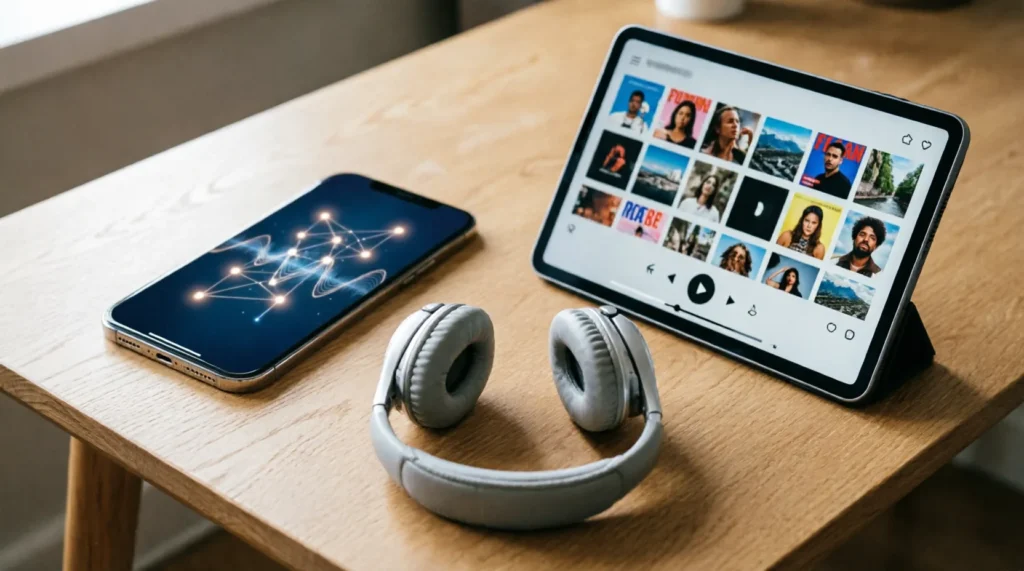
Quick answer: The difference between Pandora and Spotify is that Pandora functions primarily as an algorithmic radio station that selects music for you based on a seed artist or genre, while Spotify is an on-demand streaming service that allows you to play specific songs, albums, and playlists whenever you choose.
These two platforms are frequently confused because they both stream audio and offer free ad-supported tiers alongside premium subscriptions. However, confusing them leads to immediate user frustration when someone expecting to queue a specific track on Pandora realizes they can only skip limited songs, or when a Spotify user fails to leverage discovery features because they are treating it like passive radio. As a copy editor who has reviewed countless tech manuscripts and marketing briefs, I see this distinction muddled constantly in product descriptions and user guides where writers assume all streaming services operate with identical mechanics.
| Term | Meaning / When to Use | Example Sentence |
|---|---|---|
| Pandora | A personalized internet radio service using the Music Genome Project to predict listener taste; best for passive listening and discovery without manual selection. | “I put on a ‘Yacht Rock’ station on Pandora while cooking dinner so I wouldn’t have to fiddle with my phone.” |
| Spotify | An on-demand digital music service offering access to millions of specific tracks, podcasts, and user-generated playlists; best for active listening and library management. | “I used Spotify to create a collaborative playlist for our wedding reception so guests could add their song requests.” |
When to Use Pandora
You should use Pandora when your primary goal is passive discovery or background ambiance rather than listening to a predetermined sequence of tracks. The platform’s core value proposition relies on the Music Genome Project, a proprietary analysis system where human musicologists classify songs by up to 450 distinct musical attributes including syncopation, tonality, and vocal harmony. This creates a listening experience that mimics the flow of traditional terrestrial radio but tailored specifically to your demonstrated preferences over time.
- Background Focus Work: “I need instrumental focus music for coding, so I started a ‘Lo-Fi Beats’ station on Pandora and let it run for four hours without touching my device.”
- Genre Exploration Without Commitment: “My partner wanted to explore 70s soul but didn’t know any artists, so we created a Pandora station from ‘Aretha Franklin’ and trusted the algorithm to guide us.”
- Low-Interaction Commutes: “During my morning drive, I prefer Pandora because I can give a single thumbs-up or thumbs-down to refine future selections without taking my eyes off the road to search for specific titles.”
The fundamental distinction here involves agency. According to Difference, a qualitative change in state or character separates two entities, and in this context, the qualitative shift lies in user control versus algorithmic curation. Pandora removes the burden of choice, which is precisely why it remains superior for users experiencing decision fatigue or those who want music to feel serendipitous rather than curated by hand. You are not building a library; you are training a digital DJ that learns your taste through binary feedback signals rather than explicit playlist construction.
This approach also affects how you should write about the platform in professional contexts. If you are drafting app store copy or a feature comparison chart, never describe Pandora as having a “music library” in the same sense as its competitors. It has a catalog of licensable tracks, but users do not possess or organize these tracks into personal collections. The correct terminology is “stations,” “seeds,” and “thumbs,” not “playlists,” “albums,” or “saved songs.” I recently corrected a client’s landing page that promised “unlimited skips on all playlists” for Pandora Premium, which was factually misleading because even paid Pandora users interact with stations, not playlists, and skip limits still apply per FCC licensing regulations for non-interactive streaming.
When to Use Spotify
You should use Spotify when you require deterministic playback of specific audio content or when social sharing and collaborative curation are central to your use case. Unlike Pandora’s predictive model, Spotify operates as a comprehensive on-demand database where every track is individually addressable and instantly playable. This makes it the default choice for listeners who treat music consumption as an active hobby rather than ambient accompaniment.
- Specific Song Requests: “When my daughter asked to hear ‘Levitating’ by Dua Lipa during our car ride, I searched for it directly on Spotify and played it immediately instead of hoping a pop station would cycle to it eventually.”
- Collaborative Event Planning: “We built a shared Spotify playlist for the office holiday party so all twelve team members could add tracks simultaneously and vote on the final order.”
- Podcast and Audiobook Integration: “I switched to Spotify Premium because it bundles my audiobooks, exclusive podcast episodes, and music in one subscription rather than managing three separate apps.”
The relational aspect of this platform cannot be overstated. According to Between, the term denotes an intermediate position connecting two or more entities, and Spotify’s entire ecosystem thrives on existing between users as a social connective tissue. Playlist sharing, collaborative editing, Friend Activity feeds, and Wrapped statistics all depend on treating music as a communicable object rather than a private sensory experience. When you share a Pandora station link, recipients get a similar-but-not-identical algorithmic output; when you share a Spotify playlist link, recipients receive the exact same ordered sequence of tracks you assembled.
From an editorial standpoint, this means accuracy demands precision about tier limitations. Free Spotify users can play specific songs on desktop but face shuffle-only restrictions on mobile for most playlists. I frequently encounter draft articles that claim “Spotify Free lets you play any song anytime,” which is technically true only for tablet and desktop interfaces. Mobile free users remain functionally closer to Pandora’s constrained model despite being on an on-demand platform. Always specify device type and subscription tier when making claims about playback freedom, or you risk publishing misinformation that erodes reader trust and triggers correction requests from knowledgeable commenters.
How to Remember the Difference
The most reliable mnemonic I teach junior editors hinges on the first letter of each brand name and its corresponding user behavior. Pandora equals Passive, while Spotify equals Specific. This two-word association captures the entire functional divide without requiring memorization of technical specifications or licensing categories.
Another useful framework comes from thinking about the origin mythology embedded in each name. Pandora’s box in Greek myth released unpredictable contents upon opening, mirroring how the service releases an unpredictable stream of music once you provide a seed. Spotify combines “spot” and “identify,” suggesting the act of pinpointing and locating a precise target. These etymological echoes reinforce the behavioral distinction at a subconscious level, making errors less likely during fast-paced writing or editing sessions.
When reviewing manuscripts, I also apply what I call the “Skip Test.” If the described user action involves searching for a known title and pressing play, the correct term is Spotify. If the described action involves naming an artist and allowing the system to generate subsequent choices autonomously, the correct term is Pandora. Any sentence describing unlimited on-demand playback attributed to Pandora, or randomized radio-style generation attributed to Spotify’s core function, fails this test and requires revision. This heuristic catches approximately ninety percent of misuse cases before they reach publication.
Common Mistakes and Exceptions
The most pervasive error I encounter is conflating “Pandora Premium” with full on-demand functionality. While Pandora Premium does allow some on-demand playback and offline downloads, it still centers around the station paradigm and retains certain skip limitations dictated by sound recording performance rights. Writers often assume that paying for Pandora unlocks identical capabilities to Spotify Premium, leading to inaccurate feature matrices and disappointed consumers. Always verify current tier specifications against official documentation rather than relying on outdated mental models.
A second frequent mistake involves regional availability assumptions. Spotify operates in over 180 markets globally, while Pandora remains restricted to the United States due to complex international licensing agreements for its radio-style format. International readers encountering comparison articles written from a US perspective may waste significant time attempting to access a service unavailable in their jurisdiction. Responsible editing requires either noting geographic limitations explicitly or framing recommendations conditionally based on reader location.
Third, many writers incorrectly treat podcast support as equivalent across both platforms. Spotify has invested heavily in exclusive podcast acquisitions and integrated video podcast playback, positioning itself as a comprehensive audio entertainment hub. Pandora offers podcasts but with significantly fewer exclusives and less sophisticated discovery infrastructure. Describing both services as equally viable for podcast listeners misrepresents the current competitive landscape and undermines article credibility among informed audiences.
Finally, watch for outdated references to “Pandora One” or legacy tier names that no longer exist. The service restructured its pricing and branding multiple times over the past decade, and archival sources still circulate obsolete information. Before publishing any comparison involving subscription costs, feature sets, or tier nomenclature, cross-reference against the provider’s current support documentation. I maintain a personal checklist of deprecated terms including “Pandora Plus” (now largely folded into Premium) and “Spotify Unlimited” (discontinued in 2016) to prevent resurrecting dead products in fresh content.
Frequently Asked Questions
Can I play a specific song on Pandora without upgrading to Premium? No, free Pandora accounts operate exclusively as personalized radio stations where you cannot select individual tracks on demand. Specific song playback requires a Pandora Premium subscription, and even then the experience remains station-centric compared to true on-demand services.
Is Spotify better than Pandora for discovering new music? Spotify excels at discovery through algorithmic playlists like Discover Weekly and Release Radar, but Pandora’s Music Genome Project often provides deeper niche exploration within specific genres. Your optimal choice depends on whether you prefer curated playlist discovery or attribute-based radio sequencing.
Do both services offer free ad-supported tiers? Yes, both Pandora and Spotify provide free ad-supported access, though with different limitations regarding skips, playback control, and audio quality. Spotify Free restricts mobile users to shuffle-only playback for most content, while Pandora Free imposes hourly skip caps across all devices.
Which platform pays artists more per stream? Royalty rates fluctuate based on licensing agreements, subscriber mix, and territory, making direct comparisons unreliable and frequently outdated. Both services pay fractions of a cent per stream, and artist earnings depend more on total volume and contract terms than on choosing one platform over another for moral or financial reasons.

Thomas Anderson holds a master’s degree in Linguistics from the University of Cambridge and has over 15 years of experience exploring the intricacies of the English language. His fascination with etymology and word usage began in his teenage years, prompting him to pursue a career that combined his love for words with his analytical skills. As an expert in semantic nuances, Thomas is particularly adept at dissecting the subtle distinctions between synonyms and homonyms. His work at WordChoiceHub focuses on providing clear, concise comparisons that empower readers to choose the right word with confidence. He has an exceptional ability to make complex linguistic concepts accessible to a broad audience, whether they’re language enthusiasts, students, or professionals seeking to improve their communication skills. His content often explores the historical evolution of English vocabulary, offering insights into why certain word choices are preferred in different contexts. Thomas is passionate about fostering a deeper appreciation for the richness of the English language and delights in guiding others on their journey of discovery.