

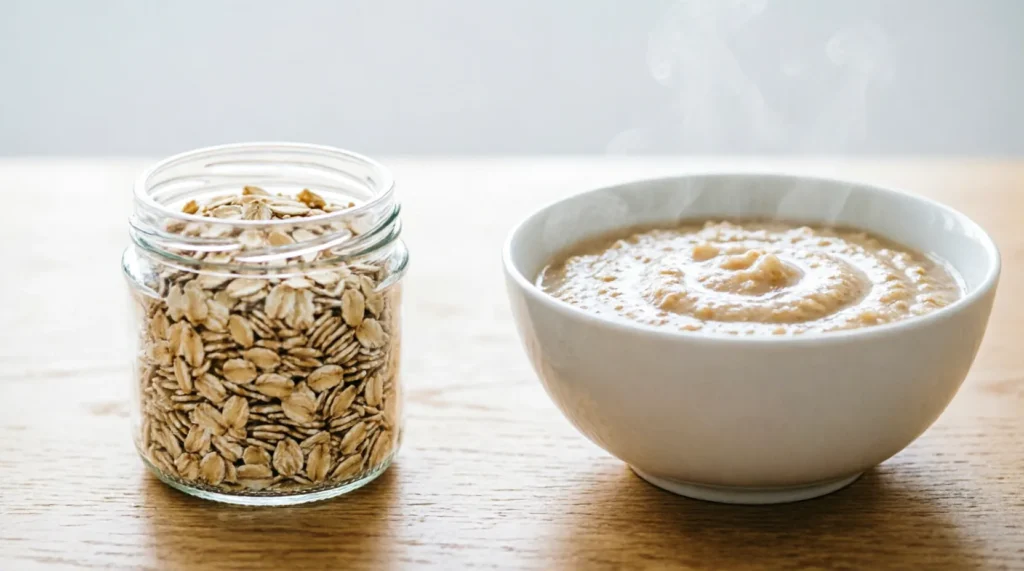
Quick answer: Oats are the raw, unprocessed cereal grain harvested from the field, while oatmeal is the cooked porridge or processed product made from those grains; you buy oats to make oatmeal, but you eat oatmeal for breakfast.
The confusion between these two terms stems from regional dialects and marketing shorthand that often uses them interchangeably on packaging. In American English, “oatmeal” frequently refers to both the dry ingredient and the finished dish, whereas British English tends to reserve “oatmeal” strictly for the coarse flour or the cooked porridge, calling the raw flakes “porridge oats.” Understanding this distinction prevents kitchen mishaps and ensures you select the correct ingredient for baking versus breakfast.
| Term | Meaning / When to use | Example sentence |
|---|---|---|
| Oats | The raw, whole, rolled, or steel-cut grain used as an ingredient in recipes. | I added a cup of rolled oats to the smoothie for extra fiber. |
| Oatmeal | The cooked porridge dish or the specific coarse-ground flour product. | She ate a bowl of cinnamon oatmeal before her morning run. |
When to Use Oats
Use the word oats when you are referring to the agricultural product or the dry pantry ingredient in its various processed forms (steel-cut, rolled, instant). This term functions as a countable or mass noun describing the physical grain itself, regardless of whether it has been steamed, flattened, or chopped. As noted in linguistic references regarding difference, distinguishing between the source material and the final preparation is essential for semantic precision in culinary writing.
In professional recipe development and food labeling, “oats” is the standard terminology for the ingredient list. You would never see “oatmeal” listed as a primary dry ingredient in a commercial granola bar formulation because the industry standard requires specificity about the grain’s state. If you are writing a grocery list, a blog post about gluten-free baking, or a nutritional analysis, “oats” is almost always the correct choice for the raw component.
- Baking Context: “This cookie recipe calls for two cups of old-fashioned oats, not the instant variety.”
- Shopping Context: “Please pick up a bag of steel-cut oats from the bulk bin at the store.”
- Agricultural Context: “The farmer rotated his soybean crop with oats to improve soil health.”
I recently edited a wellness e-book where the author consistently wrote “add oatmeal to the blender” for a raw energy ball recipe. This was technically incorrect because the reader might grab a packet of pre-sweetened instant oatmeal mix instead of plain rolled oats, resulting in a mushy, overly sweet disaster. Changing it to “rolled oats” eliminated the ambiguity and ensured the texture matched the author’s intent.
When to Use Oatmeal
Use oatmeal when you are describing the prepared dish, the hot porridge served in a bowl, or the specific coarse flour milled from oat groats. In North America, this term has expanded colloquially to include the dry instant packets, but in precise writing, it should signal either the finished meal or the ground flour product. The relationship between the grain and the dish is causal: oats are the input, and oatmeal is the output.
This term is appropriate for menu descriptions, dietary logs, and casual conversation about breakfast habits. If you are telling someone what you ate, you say “I had oatmeal,” not “I had oats,” unless you literally consumed a handful of dry raw grain. In Scottish and British contexts, “oatmeal” can also refer specifically to the unbolted, coarse flour used in traditional bannocks and puddings, which is distinct from the flaked grains Americans typically associate with the word.
- Dining Context: “The hotel buffet offers steel-cut oatmeal with fresh berries and brown sugar.”
- Culinary History Context: “Traditional Scottish oatmeal is ground to a coarse texture rather than rolled flat.”
- Casual Speech Context: “My kids refuse to eat anything for breakfast except maple-flavored oatmeal.”
Consider a resume or LinkedIn bio for a food stylist or chef. Writing “specialized in oat-based dishes” sounds clinical and detached, whereas “expert in artisanal oatmeal preparations” conveys warmth and culinary specialization. However, if that same chef were writing a supplier specification sheet, they would revert to “certified gluten-free oats” to ensure procurement accuracy. The context dictates the vocabulary.
How to Remember the Difference
The most reliable mnemonic I teach clients is the “Field vs. Bowl” test. If the word describes something still in the silo, the bag, or the mixing bowl as a dry ingredient, use oats. If the word describes something steaming in a mug, sitting on a breakfast table, or ground into fine flour, use oatmeal. Think of “oats” as the plural noun for the individual kernels and “oatmeal” as the singular mass noun for the transformed substance.
Another helpful editor’s trick is to look at the suffix. Words ending in “-meal” (cornmeal, pinhead oatmeal) typically denote a ground powder or a prepared mush, while the base word without the suffix denotes the whole or fragmented grain. If you can substitute “rice” or “wheat berries” in the sentence, use “oats.” If you can substitute “porridge” or “gruel,” use “oatmeal.” This substitution test works in 99% of usage cases and catches errors before publication.
Visualizing the processing timeline also helps cement the distinction. Oats exist at the beginning and middle of the supply chain; oatmeal exists at the end. When you are unsure, ask yourself: “Am I talking about the ingredient or the experience?” Ingredients are oats; experiences are oatmeal. This mental framework aligns with how professional food writers and lexicographers categorize these terms, removing guesswork from your drafting process.
Common Mistakes and Exceptions
The most frequent error I encounter in manuscript editing is the hypercorrection where writers avoid “oatmeal” entirely, believing it to be informal or incorrect. This leads to awkward constructions like “I enjoyed a warm bowl of oats for breakfast.” While technically defensible, this phrasing sounds unnatural to native American English speakers and disrupts the reader’s flow. Reserve “oats” for the ingredient; allow “oatmeal” for the dish. Precision does not require sacrificing idiomatic fluency.
Regional variation creates another layer of complexity. In the United Kingdom and Ireland, “porridge” is the dominant term for the cooked dish, and “oatmeal” often refers exclusively to the coarse flour. An American writer submitting content for a British audience should use “porridge oats” for the dry ingredient and “porridge” for the breakfast dish to avoid confusion. Conversely, using “oatmeal” to describe the flour in an American recipe will likely result in readers purchasing Quaker Instant packets instead of the required stone-ground product.
Marketing language has further blurred these lines. Brands like Quaker and McCann’s label their dry products as “Oatmeal” on the front of the package, even though the nutrition facts panel lists “Whole Grain Rolled Oats.” This commercial convention means that in a retail context, “oatmeal” is acceptable for the dry product, but in instructional or technical writing, maintaining the distinction demonstrates expertise. Always prioritize clarity over mimicking packaging shorthand unless you are specifically analyzing brand nomenclature.
One notable exception occurs in compound modifiers. We say “oat milk,” “oat flour,” and “oat bran,” never “oatmeal milk” or “oatmeal flour.” In attributive positions modifying another noun, the base form “oat” is grammatically mandatory. Similarly, in scientific or botanical contexts discussing Avena sativa, researchers always use “oats” or “oat grain,” never “oatmeal,” regardless of the sample’s preparation state. Recognizing these fixed collocations prevents jarring errors in specialized content.
Frequently Asked Questions
Can I use “oats” and “oatmeal” interchangeably in recipes? No, substituting one term for the other can lead to incorrect ingredient selection, as “oats” specifies the dry grain while “oatmeal” may imply a pre-mixed or cooked product. Always follow the recipe’s exact terminology to ensure proper texture and hydration ratios.
Is “oatmeal” considered a slang term or improper English? “Oatmeal” is standard, formal English when referring to the porridge or coarse flour, though using it to describe dry rolled oats is a regional American colloquialism rather than a technical definition. It is perfectly appropriate in professional food writing when used correctly to denote the prepared dish.
Why do some packages say “oatmeal” while others say “oats”? Packaging uses “oatmeal” as a consumer-friendly category name for breakfast cereals, while “oats” appears on ingredient lists to comply with food labeling regulations requiring precise identification of raw components. Trust the ingredient list for accuracy and the front label for general product categorization.
Does the difference matter for SEO and content marketing? Yes, search intent differs significantly: users searching “oats” typically seek nutritional data, baking recipes, or agricultural information, while “oatmeal” searchers want breakfast recipes, health benefits of the porridge, or product reviews. Aligning your terminology with the specific user intent improves relevance and ranking potential for targeted keywords.

Brandon Martinez is a passionate linguist with a deep love for the dynamics of the English language. He earned his Ph.D. in Applied Linguistics from Stanford University, where he focused his research on cognitive linguistics and language processing. With a career spanning over 12 years, Brandon has dedicated himself to understanding how people choose and use words in specific contexts. His connection to word comparisons was forged through years of teaching English as a second language and witnessing firsthand the challenges non-native speakers face with verbage. At WordChoiceHub, Brandon produces content that delves into the psychological factors affecting word choice, offering readers valuable strategies to enhance their linguistic precision. He specializes in exploring idiomatic expressions, phrasal verbs, and the cultural nuances that influence English word usage. His articles are well-researched and offer unique perspectives that appeal to both academic audiences and those looking to improve their everyday communication skills. Brandon is committed to making the art of word selection not only informative but also an enjoyable experience for all.