

Quick answer: Use tearing when separating soft foods by hand using tension (like basil or mozzarella), and use cutting when separating foods with a sharp tool or blade (like carrots or steak). If you are solving a crossword puzzle looking for “tearing or cutting food nine letters,” the answer is shredding, but in culinary writing, distinguishing between tearing and cutting remains essential for precision.
When writers draft recipes, food blogs, or culinary manuscripts, they frequently confuse the verbs “tearing” and “cutting.” Both words describe the act of dividing food into smaller pieces, but they imply entirely different physical actions, tools, and culinary outcomes. Choosing the wrong word not only creates grammatical sloppiness but can also mislead a home cook about the proper technique. As a veteran copy editor who has corrected this exact mistake in hundreds of food manuscripts, I can tell you that precision here separates amateur writing from professional culinary authority.
| Term | Meaning / When to use | Example sentence |
|---|---|---|
| Tearing | Separating soft, pliable food by hand using opposing physical tension, without a blade. | “Gently tear the fresh basil leaves over the finished pasta to release their aromatic oils.” |
| Cutting | Separating food into portions using a sharp tool, blade, or acutely directed force. | “Cut the butternut squash into uniform one-inch cubes to ensure even roasting.” |
When to use tearing
You should use the word “tearing” when the action involves pulling a soft, pliable food item apart using your hands, relying on tensile stress rather than a sharp edge. This term is highly specific in culinary writing. It signals to the reader that no knife is required and that the structural integrity of the food is being manipulated through manual force.
From a mechanical standpoint, this distinction is well-documented. According to the physical definition of Tearing, the process involves the fracturing and separation of material under tensile stress, which perfectly describes how we pull apart soft foods without a blade. In the kitchen, this tensile stress is applied deliberately to preserve the food’s quality. For example, tearing leafy herbs like basil, mint, or cilantro along their natural veins prevents the cellular bruising that a dull knife would cause. Bruised herbs oxidize rapidly, turning black and losing their vibrant flavor.
Here are concrete examples of how “tearing” should be used in professional writing:
- Recipe instruction: “Tear the burrata cheese into rustic chunks and scatter them over the heirloom tomatoes.” (Using “cut” here would imply a knife, which would squeeze out the creamy interior and create a messy presentation).
- Food blog narrative: “Instead of slicing the bread, I prefer tearing it into bite-sized pieces to create a more textured, authentic panzanella salad.”
- Professional resume line: “Prepared daily mise en place by hand-tearing delicate herbs and soft cheeses to maintain optimal texture and visual appeal.”
Notice how “tearing” conveys a sense of rustic, intentional, and gentle preparation. It is an intransitive or transitive verb that paints a clear picture of manual, tool-free preparation. If a food item requires a knife, scissors, or a mandoline, “tearing” is the incorrect word choice.
When to use cutting
You must use the word “cutting” when the separation of food requires a sharp tool, such as a chef’s knife, paring knife, kitchen shears, or a mandoline. This word implies precision, intentionality, and the application of a blade to overcome the structural resistance of the food.
The foundational definition of this action supports this culinary rule. As noted in the established mechanical description of Cutting, this action is the separation of a physical object into portions through the application of an acutely directed force, typically via a blade or sharp edge. In recipe writing, “cutting” is the umbrella term that encompasses more specific techniques like dicing, mincing, julienning, and chopping. However, when the exact shape does not matter, or when introducing a general preparatory step, “cutting” is the most accurate and universally understood verb.
Consider these real-world examples where “cutting” is the only correct choice:
- Recipe instruction: “Cut the chicken breast horizontally into two even cutlets before pounding them to a quarter-inch thickness.” (You cannot “tear” a raw chicken breast into even cutlets; it requires a blade).
- Email to a catering client: “We will be cutting the smoked brisket against the grain to ensure maximum tenderness for your guests.”
- Culinary school assignment: “The student was graded on their ability to keep cutting the carrots into uniform batonnet shapes throughout the practical exam.”
Using “cutting” establishes authority and clarity. It tells the reader that a tool is necessary and that the resulting pieces will likely have clean, defined edges. When I edit manuscripts, I immediately flag any instance where a writer suggests “tearing” a firm vegetable like a carrot, potato, or apple, as this is physically impossible and demonstrates a lack of basic kitchen knowledge.
How to remember the difference
To permanently banish this confusion from your writing, use this simple, editor-approved mnemonic: “Tearing Takes Two hands (or two points of tension), Cutting Calls for a tool.”
If you can visualize yourself using both hands to pull the item apart, the word is “tearing.” If you can visualize your hand gripping a handle with a blade attached, the word is “cutting.”
Here is a deeper, editor-level insight that beginners often miss: the choice between these words changes the sensory expectation of the reader. In a manuscript I edited last year, a food writer penned the sentence, “Cut the fresh mozzarella into the salad.” I changed it to “Tear the fresh mozzarella into the salad.” Why? Because cutting mozzarella with a knife often results in a squashed, uneven mess unless the knife is heated. Tearing it by hand yields those beautiful, cloud-like pockets of cheese that define a high-quality Caprese salad. The word “tearing” instructed the cook to use their hands, resulting in a better final dish.
Another practical trick is to associate “tearing” with organic, irregular shapes and “cutting” with geometric, uniform shapes. If your recipe calls for a “rustic” or “rough” appearance, you are likely tearing. If it calls for “even,” “uniform,” or “precise” pieces, you are cutting. This mental shortcut will save you from awkward phrasing in everything from LinkedIn bios to published cookbooks.
Common mistakes and exceptions
Even experienced writers stumble into a few predictable traps when describing food preparation. Being aware of these edge cases will elevate your writing from good to flawless.
Mistake 1: Using “cutting” for delicate leafy greens. As mentioned, cutting herbs like basil or spinach with a standard knife can bruise the cell walls, accelerating oxidation. While “chopping” is acceptable for hardy herbs like rosemary or thyme, “tearing” is the culinarily superior and more accurate verb for soft, broad-leafed greens. I see this error constantly in amateur food blogs, where writers default to “cut” for every preparatory action.
Mistake 2: Applying “tearing” to firm or brittle foods. You cannot tear a raw potato, an apple, or a dense block of cheddar cheese. Attempting to do so would result in a mangled mess. If the food offers significant structural resistance, “cutting” (or a more specific derivative like “slicing” or “dicing”) is the mandatory choice.
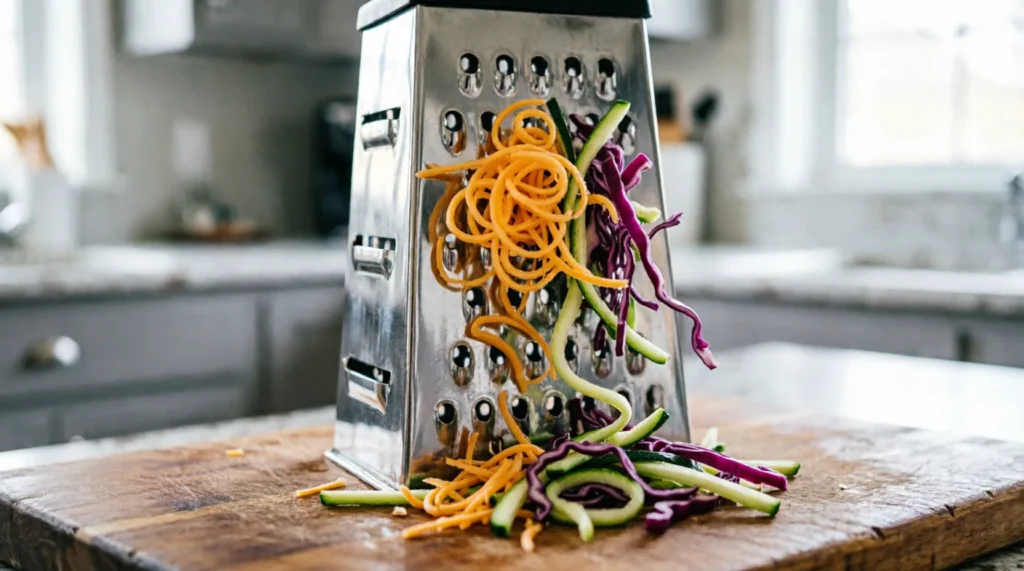
The “Nine Letters” Exception: Shredding. It is worth addressing the specific search query “tearing or cutting food nine letters” directly. If you are here because you are solving a crossword puzzle, the nine-letter word you are looking for is shredding. Shredding is a unique culinary exception because it can be achieved through both tearing (using two forks to pull apart slow-cooked pork) and cutting (using a box grater or food processor to shred cheese or cabbage). However, in standard prose and recipe writing, you should still default to the more specific verb that matches your actual method. Do not use “shredding” as a lazy catch-all in formal writing if “tearing” or “cutting” is more accurate.
US vs. UK Differences. While the core definitions of tearing and cutting remain identical across English dialects, colloquial phrasing can differ. In UK English, it is quite common to hear the phrasal verb “cutting up” (e.g., “I am cutting up the onions for the stew”). In US English, this sounds slightly juvenile or informal; an American food writer is more likely to write “chopping,” “dicing,” or simply “cutting” the onions. However, “tearing” does not have a common phrasal verb equivalent in either dialect, making it a stable, universally understood term in global culinary writing.
Frequently Asked Questions
Is it grammatically correct to say “tearing food” in a formal recipe? Yes, “tearing” is a perfectly valid gerund or present participle in formal recipe writing. It is the most precise verb to describe the manual separation of soft, pliable ingredients like herbs, cheese, or bread.
What is the nine-letter word for tearing or cutting food? If you are solving a crossword clue, the nine-letter answer for “tearing or cutting food” is shredding. In a culinary context, shredding can refer to either pulling food apart with forks (tearing) or grating it with a tool (cutting).
Does tearing herbs really make a difference compared to cutting them? Yes, it makes a significant difference. Cutting soft herbs like basil with a knife crushes the cell walls, causing them to oxidize and turn black quickly. Tearing them along their natural veins preserves the aromatic oils and maintains a vibrant green color.
Can “tearing” be used as a noun in culinary writing? While “tearing” is primarily a verb (or gerund), it is rarely used as a standalone noun in culinary writing. Instead, writers use nouns like “tears” (e.g., “add the basil in rough tears”) to describe the resulting pieces of food.

Thomas Anderson holds a master’s degree in Linguistics from the University of Cambridge and has over 15 years of experience exploring the intricacies of the English language. His fascination with etymology and word usage began in his teenage years, prompting him to pursue a career that combined his love for words with his analytical skills. As an expert in semantic nuances, Thomas is particularly adept at dissecting the subtle distinctions between synonyms and homonyms. His work at WordChoiceHub focuses on providing clear, concise comparisons that empower readers to choose the right word with confidence. He has an exceptional ability to make complex linguistic concepts accessible to a broad audience, whether they’re language enthusiasts, students, or professionals seeking to improve their communication skills. His content often explores the historical evolution of English vocabulary, offering insights into why certain word choices are preferred in different contexts. Thomas is passionate about fostering a deeper appreciation for the richness of the English language and delights in guiding others on their journey of discovery.