

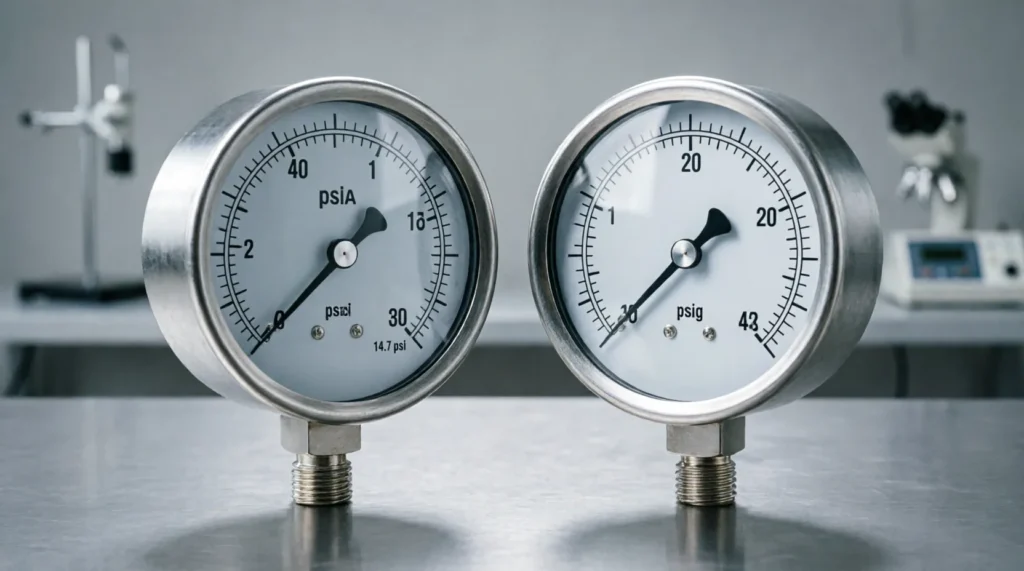
Quick answer: PSIG measures pressure relative to the current atmospheric pressure (what your gauge reads), while PSIA measures total pressure including the atmosphere; at sea level, PSIA equals PSIG plus approximately 14.7.
Engineers, technicians, and DIY enthusiasts frequently confuse these two pressure units because most mechanical gauges display zero at ambient conditions, masking the atmospheric load that absolute scales always include. This distinction is not merely academic; misinterpreting a process specification by 14.7 PSI can cause catastrophic equipment failure, incorrect gas mixture calculations, or safety valve malfunctions in industrial systems. Understanding the precise difference prevents costly errors in everything from HVAC charging to aerospace testing.
| Term | Meaning / When to use | Example sentence |
|---|---|---|
| PSIG | Pounds per square inch gauge; measures pressure relative to ambient atmosphere; reads 0 at sea level rest. | “The compressor discharge pressure stabilized at 125 PSIG after the new filter was installed.” |
| PSIA | Pounds per square inch absolute; measures total force including atmospheric pressure; reads ~14.7 at sea level rest. | “Thermodynamic calculations for the turbine efficiency require inlet pressure expressed as 140 PSIA.” |
When to Use PSIG
PSIG is the standard unit for any application where you need to know the pressure contained within a vessel or pipe relative to the outside environment. Because Bourdon tube gauges, digital manometers, and tire pressure sticks are mechanically referenced to the surrounding air, they inherently report gauge pressure. If you are setting a relief valve, checking hydraulic line integrity, or inflating tires, you are working in the gauge domain because the structural stress on the container depends only on the differential between the internal fluid and the external atmosphere.
In my years editing technical manuals and maintenance logs, I have found that 95% of field measurements should remain in PSIG unless a specific calculation demands otherwise. Using absolute pressure for routine mechanical checks introduces unnecessary conversion steps and increases the risk of transcription errors. Stick to gauge pressure when the physical hardware responds to differential force.
- The boiler operator’s logbook correctly recorded “steam header pressure at 150 PSIG” because the safety valve setpoint is calibrated to gauge reference.
- My client’s cover letter for a plant manager role originally stated “monitored reactor vessels at 300 PSIA,” which I corrected to PSIG since the control room DCS displays gauge values and the hiring manager would flag the unit mismatch immediately.
- The HVAC technician’s service ticket noted “low-side suction at 68 PSIG,” matching the manifold gauge reading directly without requiring atmospheric compensation.
When to Use PSIA
PSIA becomes mandatory whenever pressure appears in thermodynamic equations, gas laws, or any formula where pressure represents an actual energy state rather than a mechanical differential. The ideal gas law (PV=nRT), compressor performance curves, and vapor-liquid equilibrium models all require absolute pressure because molecular kinetic energy does not care about local weather; it responds to total molecular density. If you omit the atmospheric baseline in these calculations, your temperature predictions will be wrong by roughly 10% at sea level and even more at altitude.
Absolute pressure also matters in vacuum systems and high-altitude applications where the ambient reference itself changes significantly. A gauge reading of -10 PSIG means something entirely different in Denver versus Miami, but 4.7 PSIA describes the same physical vacuum state regardless of location. When specifying process conditions for simulation software, vendor datasheets, or scientific publications, default to PSIA to ensure reproducibility.
- The process engineer’s email to the catalyst supplier specified “reactor inlet at 45 PSIA and 350°F” so the vendor could accurately model reaction kinetics using their proprietary thermodynamic package.
- I once reviewed a graduate thesis where the student used gauge pressure in the Antoine equation for vapor pressure estimation; correcting the values to PSIA shifted the predicted boiling point by 8°C and saved the defense committee from rejecting the work.
- The aircraft maintenance manual requires cabin pressurization tests documented in PSIA because the environmental control system must maintain a specific absolute oxygen partial pressure for passenger physiology, not a fixed differential against variable runway altitude.
How to Remember the Difference
The most reliable mnemonic I teach junior engineers is simple: Gauge = Ground-level zero, Absolute = Always adds atmosphere. The letter G reminds you that gauge pressure starts at ground-level ambient conditions and ignores the air above it, while A reminds you that absolute pressure always includes the atmospheric column pressing down. When you see the suffix, let the first letter trigger the conceptual model before you touch a calculator.
Another editor-level trick involves visualizing the measurement device itself. Imagine holding a standard dial gauge in your hand at sea level; the needle points to zero because the internal spring balances against outside air. Now imagine sealing that same gauge inside a perfect vacuum chamber; the needle would deflect backward to -14.7 PSIG, proving that gauge readings are merely offsets from a moving baseline. Absolute pressure has no such offset—it is the true count of molecular collisions, and remembering this physical image prevents unit confusion under stress.
For quick mental math, anchor to the number 14.7 at sea level and adjust for altitude only when precision matters below 1% error tolerance. In most industrial settings within a few hundred feet of sea level, treating atmospheric pressure as a flat 14.7 constant keeps conversions fast and sufficiently accurate. Reserve detailed barometric corrections for laboratory metrology, aviation, or high-elevation mining operations where the baseline shifts enough to affect safety margins.
Common Mistakes and Exceptions
The most dangerous error I encounter in technical documentation is silently mixing units in multi-step calculations without labeling intermediate results. An engineer might read 100 PSIG from a gauge, add 14.7 mentally, then plug 114.7 into a spreadsheet column labeled simply “Pressure.” Six months later, another team member assumes that column is gauge pressure because the original source was a gauge, leading to undersized piping or overpressured vessels. Always label every numeric value with its unit suffix in spreadsheets, code comments, and handoff notes—never assume context will survive personnel turnover.
Altitude variation creates a subtle exception that catches people who memorize “add 14.7” as an immutable rule. At 5,000 feet elevation, standard atmospheric pressure drops to approximately 12.2 PSIA, meaning a gauge reading of 0 corresponds to 12.2 absolute, not 14.7. In high-mountain facilities like Colorado mines or Andean processing plants, using the sea-level constant introduces systematic error that compounds across thermodynamic cycles. Check local barometric data or install an absolute pressure transmitter if your site sits above 2,000 feet and your process tolerance exceeds 2%.
Vacuum measurements represent another edge case where terminology breaks down. Negative gauge pressure is physically meaningful (it indicates sub-atmospheric conditions), but negative absolute pressure is impossible in classical thermodynamics. When documenting vacuum systems, specify whether you mean inches of mercury vacuum, torr, or positive PSIA values below atmospheric. I have rejected countless equipment specifications that listed “-5 PSIA” as a design condition; the correct expression is either “9.7 PSIA” (at sea level) or “5 PSIG vacuum,” depending on what the instrument actually measures.
Unit conversion errors between metric and imperial systems frequently compound the PSIG/PSIA confusion. Bar(a) and bar(g) follow the identical absolute/gauge distinction, but 1 bar equals 14.504 PSI, not 14.7. Converting 10 barg to absolute requires adding 1.013 bar(a), then converting to 15.96 PSIA—not blindly adding 14.7 to a bar value. Always convert to consistent units before applying the atmospheric offset, or use a validated engineering calculator that tracks reference states internally.
Finally, beware of legacy instrumentation that may be mislabeled or recalibrated without documentation. I once audited a chemical plant where three critical reactors displayed “PSI” on faded nameplates with no suffix; investigation revealed two were gauge-referenced Bourdon tubes and one was an old absolute transducer from a decommissioned vacuum service. Never trust unlabeled pressure readings in safety-critical systems. Verify the sensor type against P&IDs, calibration certificates, or direct bench testing before incorporating values into any engineering decision.
Frequently Asked Questions
Can I just always add 14.7 to convert PSIG to PSIA? At sea level under standard conditions, adding 14.7 is accurate enough for most industrial work, but at higher elevations or during extreme weather events, actual atmospheric pressure can deviate by several PSI. For thermodynamic modeling, safety system sizing, or any application above 2,000 feet elevation, use a site-specific barometric reading or an absolute pressure sensor instead of the sea-level constant.
Why do tire pressure gauges read zero when disconnected instead of 14.7? Tire gauges measure the differential force that stretches the tire carcass, which is exactly what determines structural load and contact patch geometry. The atmosphere presses equally on both sides of the gauge diaphragm when disconnected, producing zero deflection; this mechanical design makes PSIG the natural unit for any application where containment stress matters more than molecular energy state.
Is PSIA ever displayed directly on industrial instruments? Yes, absolute pressure transmitters are common in distillation columns, compressor surge control, and vacuum systems where the process physics depend on total molecular density rather than differential force. These instruments contain a sealed vacuum reference chamber instead of a vented atmospheric port, and their output is explicitly labeled PSIA, bar(a), or kPa(abs) to distinguish them from gauge-referenced devices.
What happens if I accidentally use PSIG in the ideal gas law? Your calculated temperature, volume, or molar quantity will be systematically low by approximately 10% at sea level because you have omitted the atmospheric contribution to molecular kinetic energy. In reactor design or gas blending, this error propagates through downstream calculations and can result in off-spec product, inadequate cooling capacity, or unsafe operating conditions that pass initial review but fail during commissioning.

Thomas Anderson holds a master’s degree in Linguistics from the University of Cambridge and has over 15 years of experience exploring the intricacies of the English language. His fascination with etymology and word usage began in his teenage years, prompting him to pursue a career that combined his love for words with his analytical skills. As an expert in semantic nuances, Thomas is particularly adept at dissecting the subtle distinctions between synonyms and homonyms. His work at WordChoiceHub focuses on providing clear, concise comparisons that empower readers to choose the right word with confidence. He has an exceptional ability to make complex linguistic concepts accessible to a broad audience, whether they’re language enthusiasts, students, or professionals seeking to improve their communication skills. His content often explores the historical evolution of English vocabulary, offering insights into why certain word choices are preferred in different contexts. Thomas is passionate about fostering a deeper appreciation for the richness of the English language and delights in guiding others on their journey of discovery.