

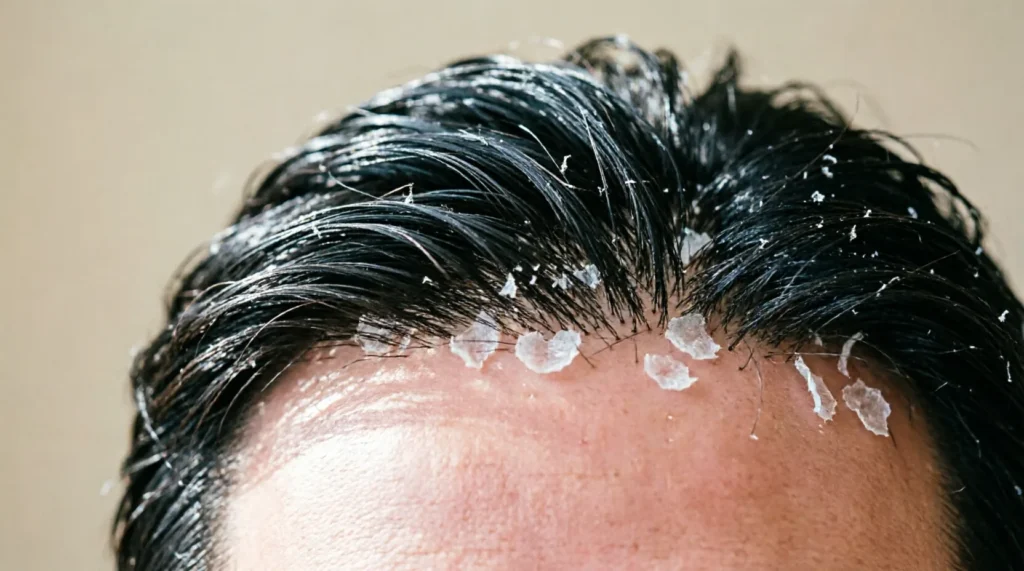
Quick answer: If the flakes are yellowish, oily, and accompanied by an itchy, red scalp, you are dealing with dandruff. If the flakes are white, dry, and your hair feels heavy, dull, or greasy at the roots despite washing, you are experiencing product build up.
Both conditions present as visible white or yellowish flakes on the scalp and shoulders. Both can cause persistent itchiness and make hair look visibly unkempt. However, their root causes are entirely different. One is a biological reaction involving a naturally occurring yeast, while the other is a cosmetic accumulation of styling residues. Misdiagnosing the issue leads to using the wrong treatments, which can actively worsen the condition and damage your hair health.
| Term | Meaning / When to use | Example sentence |
|---|---|---|
| Dandruff | A biological scalp condition caused by yeast overgrowth, leading to oily, yellowish, or white flakes and inflammation. Use when discussing medical scalp flaking, persistent itchiness, or redness. | “I need to buy a zinc pyrithione shampoo because my itchy, yellowish flakes indicate dandruff, not just dry hair.” |
| Product build up | The accumulation of hair care residues (like silicones, waxes, and polymers) on the scalp and hair shaft, causing dullness, heaviness, and dry, white flakes. Use when discussing residue from styling products, dry shampoo, or heavy conditioners. | “After a week of using texturizing spray, my hair feels stiff and my scalp is flaking, which is a classic sign of product build up.” |
When to use dandruff
Dandruff is a medical and biological scalp condition, not a hygiene failure. According to the clinical overview of Dandruff, this condition is frequently linked to an overgrowth of a yeast-like fungus called Malassezia globosa. This microbe naturally lives on everyone’s scalp and feeds on scalp oils, known as sebum.
As it breaks down sebum, it produces oleic acid. About 50% of the global population is sensitive to this acid. In sensitive individuals, oleic acid penetrates the stratum corneum (the outermost layer of skin), triggering an inflammatory response. This inflammation accelerates skin cell turnover, causing cells to shed in large, visible clusters rather than as invisible, microscopic particles.
You should use the term “dandruff” when the flakes are accompanied by scalp redness, persistent itchiness, or a greasy texture. The flakes themselves are often larger, clump together, and may have a distinct yellowish tint due to the presence of excess sebum. Stress, hormonal fluctuations, and cold, dry weather can exacerbate this biological process.
- Dermatologist email: “Dear Dr. Evans, I have been experiencing persistent scalp itching and large, yellowish flakes for three weeks. I suspect this is dandruff rather than a simple dry scalp, and I would like to discuss prescription-strength ketoconazole options.”
- Personal care journal: “Noticed increased flaking after periods of high stress. The flakes are slightly oily and stick to the scalp, confirming it is dandruff and not just winter dryness.”
- Text to a friend: “I can’t wear black shirts right now because my dandruff is acting up. I need to switch back to my medicated shampoo ASAP.”
When to use product build up
Product build up is a cosmetic issue, not a medical one. It occurs when hair care formulations accumulate on the hair shaft and scalp faster than they can be washed away by regular, mild shampoos. According to the general definition of a manufactured Product, these hair care formulations are designed to alter texture or appearance, but their residual, non-water-soluble components can create a physical barrier on the scalp over time.
Common culprits include dimethicone, cyclomethicone, polyquaterniums, acrylates, and natural waxes like beeswax or heavy shea butter. These ingredients are often not fully water-soluble. They require specific, stronger surfactants (like sodium laureth sulfate) to be effectively emulsified and rinsed away. When gentle, sulfate-free cleansers are used exclusively, these residues layer upon layer.
You should use the term “product build up” when the flakes are dry, powdery, and stark white. Additionally, the hair will feel unusually heavy, limp, or greasy at the roots shortly after washing. It is essentially a physical layer of trapped dirt, natural oil, and cosmetic residue blocking the scalp from breathing.
- Salon consultation note: “Client complains of dull, lifeless hair and white, powdery flakes at the crown. Given her daily use of volumizing mousse and dry shampoo, this is clearly product build up, not a scalp disorder.”
- Text to a friend: “My hair feels so heavy and looks greasy even though I washed it yesterday. I think all this hairspray is causing major product build up.”
- Personal care journal: “Did a clarifying wash today. The water ran gray, and my scalp immediately felt lighter. The previous flaking was definitely product build up from the leave-in conditioner.”
How to remember the difference
The easiest way to remember the difference is the “Yeast vs. Yuck” mnemonic. Dandruff is driven by Yeast (Malassezia), making the flakes oily and the scalp biologically irritated. Product build up is just Yuck (residual gunk), making the flakes dry, powdery, and the hair physically heavy.
For a practical, editor-level diagnostic trick, use the “Tissue Test.” When you see a flake on your shoulder, pick it up and rub it firmly between your thumb and index finger over a white tissue. If the flake smears and leaves a slightly oily or waxy residue, it is dandruff, as it is rich in sebum. If it crumbles instantly into a fine, dry powder with no grease, it is product build up (or simple dry scalp).
You can also rely on the “Two-Day Clarifying Rule.” Wash your hair with a dedicated, sulfate-based clarifying shampoo. If the flakes vanish and your scalp feels completely normal after one or two washes, it was product build up. If the itching and flaking persist despite thorough clarifying, you are dealing with the biological reality of dandruff, which requires active, medicated ingredients to manage.
Common mistakes and exceptions
Confusing dry scalp with dandruff: A dry scalp produces small, dry, white flakes without the oiliness, yellowing, or redness of true dandruff. People often buy harsh anti-dandruff shampoos for a dry scalp. This strips the scalp of its remaining natural oils, worsening the dryness and creating a vicious cycle of flaking.
The Sulfate Phobia Trap: Many people avoid sulfates due to online beauty trends, using only gentle, sulfate-free cleansers. While excellent for color-treated hair, these cleansers often lack the chemical power to remove silicones and polymers. Using them exclusively almost guarantees product build up over time.
Exception: Seborrheic dermatitis: This is a more severe, inflammatory form of dandruff. If the scalp is extremely red, weeping, or covered in thick, crusty yellow scales that extend beyond the hairline to the eyebrows or nose, it has crossed from simple dandruff into seborrheic dermatitis. This requires a dermatologist’s care and stronger prescription treatments.
US vs UK Differences: In American English, the term is frequently written as two words (“product build up”) or as a single compound word (“product buildup”). In British English, it is standard to hyphenate the noun form as “product build-up”. Additionally, you will see “sulfate-free” in US marketing, whereas UK publications and product labels will spell it “sulphate-free”. Recognizing these regional spelling variations prevents confusion when reading international hair care guides.
Real-World Usage: Error vs. Fix
- Email to a stylist:
- Error: “Hi, my scalp is flaking and itchy. I think I have product build up, so I’ve been scrubbing it with dish soap to clean it.”
- Fix: “Hi, my scalp is flaking with yellowish, oily patches. I realize now this is dandruff, not product build up, so I will switch to a ketoconazole shampoo instead of using harsh detergents.”
- Resume line (for a Trichologist or Salon Manager):
- Error: “Specialized in treating client dandruff using heavy clarifying scrubs and sulfate stripping.” (This is incorrect because clarifying scrubs treat build up, and harsh stripping aggravates dandruff).
- Fix: “Specialized in accurately diagnosing whether client flaking is dandruff or product build up, prescribing targeted medicated or clarifying regimens accordingly.”
- Text message to a friend:
- Error: “My hair is so flaky and gross. I must have dandruff, even though I just bought this expensive medicated shampoo and it’s not working at all.”
- Fix: “My hair is flaky and feels heavy at the roots. I think it’s actually product build up from that new dry shampoo, not dandruff, so I’m going to do a clarifying wash instead.”
Frequently Asked Questions
Can product build up cause actual dandruff? No, product build up itself does not cause the biological yeast overgrowth that defines dandruff. However, a heavy layer of residue can trap sweat and natural oils against the scalp, creating a warm, moist environment that may indirectly encourage yeast proliferation and mimic dandruff symptoms.
How do I test if my flakes are dandruff or product build up at home? Perform a clarifying wash using a sulfate-based clarifying shampoo to thoroughly strip the hair and scalp. If the flakes vanish and your scalp feels normal, it was product build up. If the itching and flaking persist after two clarifying washes, you are likely dealing with dandruff.
Does dry shampoo cause dandruff or product build up? Dry shampoo primarily causes product build up. Its active ingredients, like rice starch or aluminum starch, are designed to absorb oil but leave a powdery residue. If not washed out regularly, this residue accumulates, leading to dry, white flakes and scalp irritation that is often mistaken for dandruff.
Can I use anti-dandruff shampoo to fix product build up? It is not the most effective solution. While the surfactants in anti-dandruff shampoos will clean the hair, you are paying a premium for active medicinal ingredients that your scalp does not need. A dedicated, affordable clarifying shampoo or an apple cider vinegar rinse will remove product build up much more efficiently.

Thomas Anderson holds a master’s degree in Linguistics from the University of Cambridge and has over 15 years of experience exploring the intricacies of the English language. His fascination with etymology and word usage began in his teenage years, prompting him to pursue a career that combined his love for words with his analytical skills. As an expert in semantic nuances, Thomas is particularly adept at dissecting the subtle distinctions between synonyms and homonyms. His work at WordChoiceHub focuses on providing clear, concise comparisons that empower readers to choose the right word with confidence. He has an exceptional ability to make complex linguistic concepts accessible to a broad audience, whether they’re language enthusiasts, students, or professionals seeking to improve their communication skills. His content often explores the historical evolution of English vocabulary, offering insights into why certain word choices are preferred in different contexts. Thomas is passionate about fostering a deeper appreciation for the richness of the English language and delights in guiding others on their journey of discovery.