

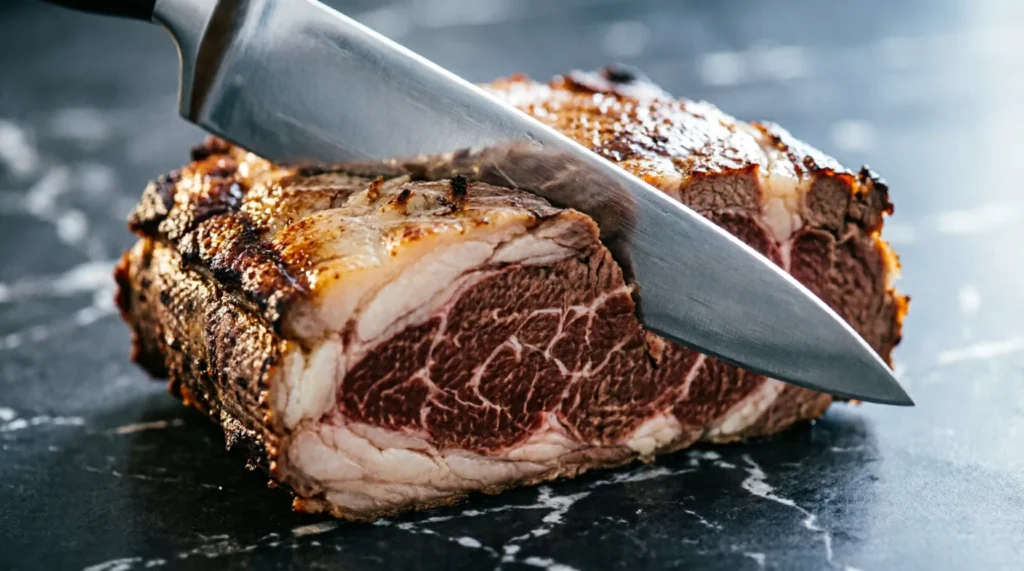
Quick answer: Always cut meat against the grain for maximum tenderness. Cutting with the grain leaves long muscle fibers intact, making even expensive steaks chewy and tough.
You’ve probably seen both phrases in recipes and wondered which direction actually matters. The difference between slicing against or with the grain separates tender, restaurant-quality meat from a chewy disappointment. I’ve corrected this mistake in countless cooking manuscripts and recipe edits over my fifteen years as a food copy editor, and it remains one of the most common errors home cooks make.
| Term | Meaning / When to use | Example sentence |
|---|---|---|
| Against the grain | Cut perpendicular to the muscle fibers; use for all cooked meats requiring slicing | “Slice the flank steak against the grain to ensure each bite is tender.” |
| With the grain | Cut parallel to the muscle fibers; generally avoid unless specifically instructed | “Cutting with the grain leaves long fibers intact, making the meat tough and stringy.” |
When to use against the grain
Cut against the grain whenever you’re slicing cooked meat that has visible muscle fibers. This means positioning your knife at a 90-degree angle to the direction the fibers run, effectively shortening them with each cut. When you slice against the grain, you’re cutting through the muscle fibers rather than along them, which makes the meat dramatically more tender and easier to chew.
The rule applies to virtually every cut of meat you’ll slice after cooking:
- Beef steaks (flank, skirt, hanger, flat iron)
- Roasts (brisket, chuck, round)
- Pork (tenderloin, loin roasts, shoulder)
- Poultry (chicken breast, turkey)
- Game meats (venison, elk)
Here are real examples I’ve seen in my editing work:
Example 1 – Email to a friend:
- Wrong: “I grilled the flank steak and just cut it straight down, but it was so chewy we could barely eat it.”
- Right: “I grilled the flank steak and sliced it against the grain, and it was incredibly tender.”
Example 2 – Recipe card:
- Wrong: “After resting, cut the brisket into 1/4-inch slices.”
- Right: “After resting, identify the grain direction and cut the brisket against the grain into 1/4-inch slices.”
Example 3 – Text message about dinner:
- Wrong: “The roast was expensive but turned out tough. Don’t know what I did wrong.”
- Right: “The roast was expensive but turned out amazing once I sliced it against the grain.”
According to Grain, the grain refers to the alignment of muscle fibers in meat, and cutting perpendicular to this alignment is essential for tenderness. When you cut against the grain, you’re essentially doing the work of your teeth before the meat even reaches the plate. Each slice has shorter muscle fibers, requiring less chewing effort and releasing more flavor.
The angle matters too. For extremely tough cuts like brisket or flank steak, I recommend cutting at a slight diagonal against the grain rather than a perfect 90-degree perpendicular cut. This creates wider slices that still have shortened fibers but provide better mouthfeel and presentation.
When to use with the grain
Cutting with the grain means slicing parallel to the muscle fibers, leaving them long and intact. In nearly all cooking scenarios, this is the wrong approach. However, there are a few specific exceptions where cutting with the grain serves a purpose, usually as an intermediate step before a final cut against the grain.
When you might cut with the grain:
- Initial portioning of large roasts: When breaking down a whole brisket or large roast, you may first cut with the grain to separate sections, then slice those sections against the grain for serving.
- Making jerky: Some jerky recipes call for cutting with the grain to create chewier, more traditional texture (though this is a specific textural goal, not tenderness).
- Certain charcuterie preparations: When making specific cured meats where fiber length affects the final product’s characteristics.
Example from my editing files:
Recipe instruction that needed correction:
- Original (wrong): “Slice the cooked pork loin with the grain for serving.”
- Corrected: “Slice the cooked pork loin against the grain for serving.”
The key is understanding that “with the grain” is almost never your final cutting direction for serving cooked meat. If a recipe tells you to cut with the grain, read the next step carefully—it likely instructs you to then cut those pieces against the grain.
I once edited a barbecue cookbook where the author repeatedly instructed readers to “cut with the grain” for serving brisket. Every single instance needed correction to “against the grain.” The author had confused the initial separation of the point and flat muscles (where some with-the-grain cutting occurs) with the final slicing for service.
How to remember the difference
Use this simple mnemonic: “Against = Advantage” or “Short fibers = Superior tenderness.”
Here’s the editor-level trick I teach in my cooking classes: Before you even start cooking, identify the grain direction on the raw meat. Look for the parallel lines running through the muscle. Once you know which way the grain runs, mentally mark it with your finger or even make a small score on the cutting board. After cooking, the grain can be harder to see, especially on darker meats or heavily seasoned cuts.
Another memory aid: Think of the muscle fibers like a bundle of uncooked spaghetti. If you try to bite through a full strand of spaghetti lengthwise (with the grain), it’s tough and stringy. But if you snap that spaghetti strand in half or into smaller pieces (against the grain), it’s much easier to chew.
I keep a small reference card in my own kitchen that simply says: “FIBERS LONG = TOUGH. FIBERS SHORT = TENDER.” It sounds obvious when written out, but in the moment, when you’re hungry and ready to eat, it’s easy to forget and just start slicing.
Visual learners can remember it this way: The grain lines look like parallel roads on a map. Cutting with the grain means driving along those roads. Cutting against the grain means building a cross-street that intersects them. You want those cross-streets (cuts) every quarter-inch or so.
Common mistakes and exceptions
Mistake #1: Not identifying the grain before cooking The grain can shift direction in different parts of the same cut, especially in larger muscles like brisket or chuck roast. I’ve seen cooks assume the grain runs one direction throughout, only to discover halfway through slicing that it changed. Always check the grain direction immediately before slicing, not when the meat is raw.
Mistake #2: Slicing too thick even when cutting against the grain Cutting against the grain helps, but if your slices are half an inch thick, you’re still leaving too much fiber to chew through. For tough cuts like flank or skirt steak, aim for 1/4-inch slices or thinner. I once corrected a recipe that said “slice the flank steak” without specifying thickness—the tested version needed “slice the flank steak thinly (no more than 1/4 inch) against the grain” to actually work.
Mistake #3: Confusing grain direction in multi-muscle cuts Some cuts, like a whole tri-tip or certain roasts, contain multiple muscles with grains running in different directions. You may need to separate these muscles first, then slice each against its own grain. According to Against, the preposition indicates opposition or contrary direction—in this case, your knife opposing the fiber direction.
Mistake #4: Cutting before the meat has rested Even if you cut against the grain perfectly, slicing meat immediately after cooking causes the juices to run out, leaving you with dry, less flavorful meat. Let steaks rest for 5-10 minutes and large roasts for 15-20 minutes. The fibers relax during resting, making them easier to identify and slice cleanly.
Exception: Ground and mechanically tenderized meat Obviously, ground meat has no grain direction to worry about. Similarly, meats that have been blade-tenderized or needle-tenderized have already had their fibers physically broken, so grain direction matters less (though slicing against any remaining grain still helps).
US vs. UK terminology note: Both American and British English use “against the grain” and “with the grain” identically when discussing meat. There’s no regional variation in this culinary term. However, British recipes more frequently use “carve” where American recipes might say “slice,” but the grain principle remains identical.
Frequently Asked Questions
How do I find the grain on a cooked piece of meat? Look for the parallel lines or striations on the meat’s surface—these are the muscle fibers. If they’re hard to see, gently pull at the meat with a fork; it will naturally separate along the grain direction. On darker meats, use good lighting and look for the subtle line patterns.
What if I already cut the meat with the grain—can I fix it? Yes, but imperfectly. Take each slice and cut it again, this time perpendicular to the original cut (effectively against the grain). You’ll end up with smaller, bite-sized pieces rather than elegant slices, but the texture will improve. This works well for stir-fries or tacos where slice appearance matters less.
Does cutting against the grain matter for tender cuts like filet mignon? Less so, but it still helps. Filet mignon and other naturally tender cuts have finer, less dense muscle fibers, so the difference is less dramatic. However, cutting against the grain still maximizes tenderness and is considered proper technique. For premium cuts, you want every advantage.
Why do some recipes not mention cutting against the grain? Many recipe writers assume readers already know this fundamental technique, or they’re simply unaware of how crucial it is. This is why I always add explicit grain-direction instructions when editing recipes. If a recipe doesn’t specify, assume you should cut against the grain for any meat you’re slicing.

Betty Walker is a seasoned editor and English language specialist with over a decade of experience in the field. She holds a bachelor’s degree in English Literature from Yale University, where she developed her keen eye for detail and her passion for precise language use. Betty’s journey into word comparisons was sparked by her work as an editor, where she frequently encountered the need for clarity between similar terms. As an advocate for clear and effective communication, she is committed to helping others navigate the complexities of English word choices. At WordChoiceHub, Betty crafts content that demystifies language puzzles and enriches readers’ vocabularies. Her areas of expertise include distinguishing commonly confused words and providing practical guidance for their usage in real-world scenarios. Known for her insightful and engaging writing style, she enjoys creating content that resonates with both native speakers and ESL learners, emphasizing the importance of context in influencing word choice.