

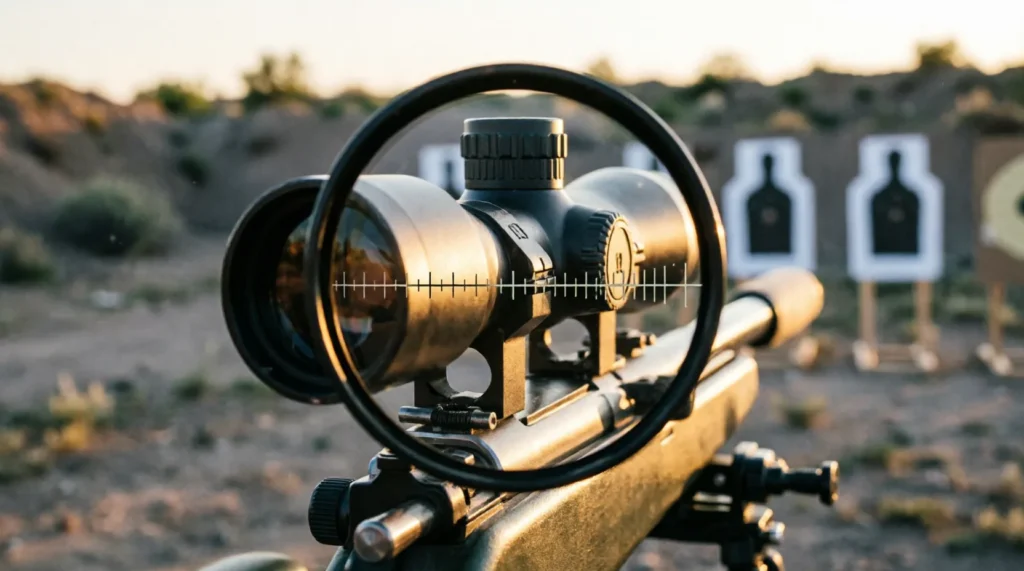
Quick answer: MRAD (milliradian) is a metric-based angular measurement where 1 mil equals 3.6 inches at 100 yards, while MOA (minute of angle) is an imperial-based system where 1 MOA equals 1.047 inches at 100 yards; they are not interchangeable, and mixing turrets with reticles causes significant aiming errors.
Shooters frequently confuse these two angular measurement systems because both describe the same physical concept: a slice of a circle used to adjust sights or estimate range. The confusion arises not from the math itself, but from the fact that most commercial optics use hybrid naming conventions, marketing shorthand, and rounded numbers that obscure the fundamental difference between mrad and moa. When a scope turret clicks in milliradians but the reticle subtends in minutes of angle, the shooter is effectively trying to measure distance in kilometers while reading a ruler marked in feet.
| Term | Meaning / When to use | Example sentence |
|---|---|---|
| MRAD (Mil) | Metric angular unit; 1/1000th of a radian; use for tactical shooting, metric ranging, and matching mil-dot reticles. | “I dialed 2.4 mils up to compensate for bullet drop at 800 meters.” |
| MOA | Imperial angular unit; 1/60th of a degree; use for hunting, imperial ranging, and matching MOA reticles. | “The windage knob requires 6 MOA right to center the impact at 300 yards.” |
When to Use MRAD
MRAD, short for milliradian, is the standard unit for military, law enforcement, and competitive precision rifle shooters who operate primarily in metric environments or require decimal-based calculations. Because the radian is a dimensionless ratio derived from the radius of a circle, between any two points on a sphere, the milliradian scales perfectly regardless of distance without requiring conversion factors like 1.047. This makes mental math significantly faster when estimating range or holding for wind in meters.
- Tactical and Military Applications: If your data book is in meters and your ballistic solver outputs solutions in mils, you must use an MRAD optic to avoid translation errors under stress; I once watched a competitor lose a PRS stage because he mentally converted 3.2 mils to MOA, missed the correction, and dropped three targets.
- Metric Ranging Estimation: When using a mil-dot reticle to estimate the distance to a target of known size, the formula (target size in meters × 1000 ÷ mils read) yields a direct meter result with no rounding, whereas the MOA equivalent requires multiplying by 95.5 or remembering the constant 27.77 for inches-to-yards.
- Decimal Precision Adjustments: MRAD turrets typically adjust in 0.1 mil increments, which translates to exactly 1 centimeter at 100 meters; this base-10 alignment means that if your ballistics app says “come up 4.7 mils,” you simply count 47 clicks without performing fractional arithmetic.
When to Use MOA
MOA, or minute of angle, remains the dominant system for American hunters, traditional target shooters, and anyone whose ballistic data is generated in yards and inches. While mathematically less elegant than the radian, MOA has a practical advantage at common hunting distances: 1 MOA is roughly 1 inch at 100 yards, making it intuitively easy to visualize holdovers and corrections without a calculator.
- Hunting and Field Shooting: Most hunting riflescopes sold in North America feature MOA turrets because field judges and game wardens think in inches; when a hunter tells me “I need to come up 3 inches at 200 yards,” that translates directly to 1.5 MOA, whereas converting to mils introduces unnecessary cognitive load during a fleeting shot opportunity.
- Imperial Ballistic Data: If your Kestrel or Strelok profile outputs elevation in MOA and your dope card lists wind holds in MOA, using an MRAD scope forces you to either reconfigure your entire system or perform real-time division by 3.438; I corrected a manuscript last year where the author claimed his .308 load required “2.1 mils” at 400 yards, but his actual chronograph data showed 7.2 MOA—he had accidentally swapped units and published dangerous misinformation.
- Legacy Optics and Reticles: Many classic hunting scopes and older competition optics use MOA exclusively; attempting to pair a modern MRAD turret with a vintage MOA reticle creates a mismatch where the subtensions no longer correspond to the click values, rendering the reticle useless for holdovers and forcing the shooter to rely solely on dialing.
How to Remember the Difference
The most reliable memory trick I teach new shooters is the “Base-Ten vs. Base-Sixty” rule: MRAD lives in base-ten (metric, decimals, 1000), while MOA lives in base-sixty (degrees, fractions, 60 minutes per degree). When you see a decimal point in your adjustment value (e.g., 1.5, 3.2, 0.8), you are almost certainly working in MRAD; when you see whole numbers or common fractions (e.g., 2, 4.5, 6), you are likely in MOA.
Another editor-level insight that prevents costly mistakes is to match your turret to your reticle before you ever mount the scope. I keep a laminated card in my range bag that reads “MIL TURRET = MIL RETICLE / MOA TURRET = MOA RETICLE” because even experienced shooters have purchased mismatched optics during sales or private transactions; if your reticle has dots spaced at 1-mil intervals but your turrets click in ¼-MOA increments, every holdover will be wrong by a factor of 3.438, and no amount of practice will fix the underlying mechanical incompatibility.
Finally, anchor the distinction to a physical reference at 100 yards: 1 MRAD = 3.6 inches (roughly the width of a credit card plus a thumb), while 1 MOA = 1.047 inches (roughly the diameter of a quarter). When you can visualize the actual size difference on a target at a familiar distance, the abstract angular measurements become concrete, and you stop treating them as interchangeable synonyms.
Common Mistakes and Exceptions
The single most pervasive error I encounter in gun forums and product reviews is the assumption that “mil” and “MOA” are just different names for the same adjustment; according to difference in mathematical terminology, two quantities may describe similar phenomena yet remain fundamentally distinct in scale and application, and this distinction matters every time you turn a turret. A shooter who believes 1 mil equals 1 MOA will miss a 600-yard target by nearly 14 inches, because the actual ratio is 1 mil = 3.438 MOA.
- Rounding Errors in Marketing: Many manufacturers advertise “1 MOA = 1 inch at 100 yards” as a convenient approximation, but the true value is 1.047 inches; at 1000 yards, this rounding error accumulates to 4.7 inches, which is enough to miss a steel silhouette entirely, so always verify whether your optic uses true MOA or the rounded “shooter’s MOA” (SMOA) before trusting long-range solutions.
- Hybrid Optics Exist: Some scopes feature MRAD turrets with MOA reticles (or vice versa) due to manufacturing leftovers or regional market adaptations; these are not defects, but they require you to either convert all holds mathematically or replace one component, and I have seen three separate students fail qualification courses because they assumed their hybrid scope was matched.
- Regional Spelling Variations: In British and Commonwealth English, you may encounter “milliradian” spelled with double-l or “minute of angle” abbreviated as “min,” but the numerical values remain identical; however, some older European optics use the NATO mil (6400 mils per circle) instead of the true mathematical radian (6283 mils per circle), creating a 1.9% discrepancy that compounds at extreme ranges and must be accounted for in precision work.
- Click Value Mislabeling: Budget optics sometimes label turrets as “1/4 MOA” when they actually adjust in 0.25 SMOA or even 0.1 MRAD disguised as MOA; always confirm actual click value by measuring group shift at a known distance rather than trusting the engraving, especially when purchasing secondhand or from non-specialist retailers.
Frequently Asked Questions
Can I use an MRAD scope with MOA ballistic data? Yes, but you must convert every solution before dialing or holding; divide MOA values by 3.438 to get mils, or multiply mils by 3.438 to get MOA, and never assume the numbers transfer directly.
Is MRAD more accurate than MOA? Neither system is inherently more accurate; accuracy depends on optic quality, shooter skill, and consistent unit matching, though MRAD’s base-10 scaling reduces calculation errors in metric environments.
Why do military snipers prefer MRAD over MOA? Military forces worldwide standardized on metric measurements decades ago, and MRAD’s direct relationship to meters eliminates conversion steps during rapid engagements, reducing cognitive load and communication errors in team environments.
How do I check if my scope is truly matched? Set up a target at exactly 100 yards, dial 10 clicks in one direction, measure the actual point-of-impact shift in inches, then divide by 10; if the result is ~0.36 inches per click, it’s MRAD; if ~0.26 inches, it’s true MOA; if ~0.25 inches, it’s SMOA—and only then compare to your reticle subtensions.

Brandon Martinez is a passionate linguist with a deep love for the dynamics of the English language. He earned his Ph.D. in Applied Linguistics from Stanford University, where he focused his research on cognitive linguistics and language processing. With a career spanning over 12 years, Brandon has dedicated himself to understanding how people choose and use words in specific contexts. His connection to word comparisons was forged through years of teaching English as a second language and witnessing firsthand the challenges non-native speakers face with verbage. At WordChoiceHub, Brandon produces content that delves into the psychological factors affecting word choice, offering readers valuable strategies to enhance their linguistic precision. He specializes in exploring idiomatic expressions, phrasal verbs, and the cultural nuances that influence English word usage. His articles are well-researched and offer unique perspectives that appeal to both academic audiences and those looking to improve their everyday communication skills. Brandon is committed to making the art of word selection not only informative but also an enjoyable experience for all.