

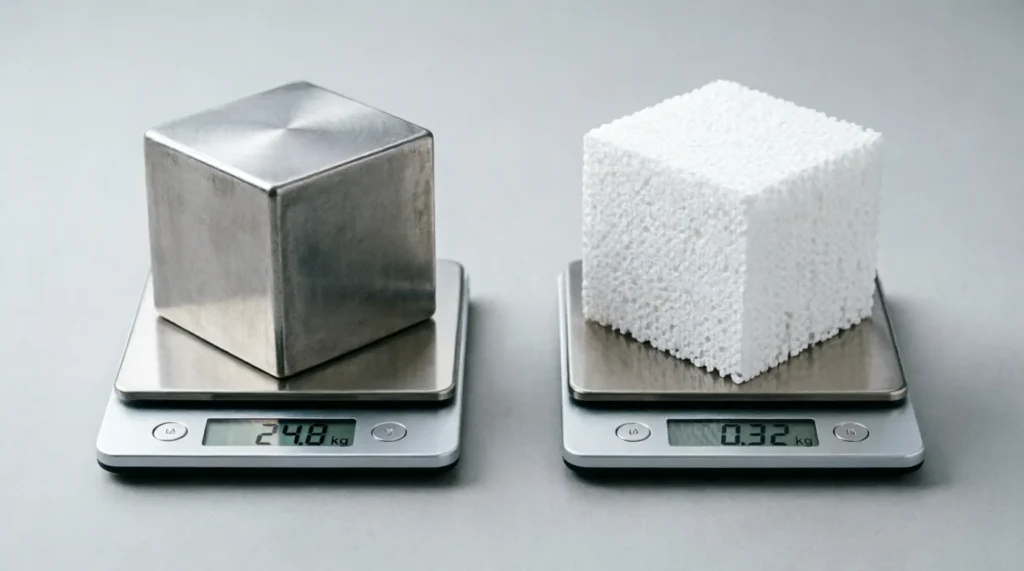
Quick answer: Mass measures the total amount of matter in an object (kilograms), while density measures how tightly that matter is packed into a specific volume (kg/m³); mass tells you “how much,” and density tells you “how compact.”
People frequently confuse these two physics terms because they often correlate in daily experience, but they describe fundamentally different properties. In my years editing science textbooks and technical manuscripts, I see writers incorrectly use “dense” when they mean “heavy,” or assume that a larger object automatically has more mass regardless of its composition. Understanding the precise distinction is critical for accuracy in engineering, chemistry, and even everyday descriptions of materials.
| Term | Meaning / When to Use | Example Sentence |
|---|---|---|
| Mass | The quantity of matter in an object; independent of location or gravity. | The astronaut’s mass remained 70 kg on the moon, even though her weight changed. |
| Density | The ratio of mass to volume; indicates how tightly packed the matter is. | Lead sinks in water because its density (11,340 kg/m³) exceeds that of water. |
When to Use Mass
Use mass when you are quantifying the absolute amount of matter in an object, regardless of its size, shape, or environment. Mass is an extensive property, meaning it depends on the total quantity of material present. According to Difference, distinguishing between related concepts requires identifying whether a term refers to an intrinsic quantity or a relational ratio; mass is always the former.
In professional and technical writing, mass is the correct term when discussing inertia, gravitational attraction, or conservation laws. Never substitute “weight” for mass unless you are specifically describing the force of gravity acting on an object at a specific location.
- Resume/CV context: “Calculated the total mass of reactants needed for scale-up production, ensuring stoichiometric balance within 0.5% tolerance.” (Incorrect: “Calculated the total density of reactants…”)
- Email to a supplier: “Please confirm the net mass of each shipment; our freight costs are based on kilogram totals, not package dimensions.” (Incorrect: “Please confirm the net density of each shipment…”)
- Lab report: “The sample’s mass was recorded as 250.00 g before heating; post-heating mass loss indicated moisture content.” (Incorrect: “The sample’s density was recorded as 250.00 g…”)
Mass remains constant whether the object is on Earth, in orbit, or submerged in fluid. If your sentence involves counting atoms, measuring inertia, or applying Newton’s second law (F=ma), mass is invariably the correct term.
When to Use Density
Use density when you need to describe the compactness of matter or compare how much mass occupies a given space. Density is an intensive property, meaning it does not change with the amount of substance; a gold ring and a gold bar have identical densities despite vastly different masses. This concept defines the relationship between two measurable quantities, and as explained in Between, relational terms require both elements to be defined for the comparison to hold meaning.
Density is the appropriate term when discussing buoyancy, material identification, purity testing, or phase changes. It answers the question “How heavy is this for its size?” rather than “How heavy is this overall?”
- Product description: “This aerospace alloy was selected for its low density (2.7 g/cm³), reducing fuel consumption without sacrificing structural integrity.” (Incorrect: “…selected for its low mass…”)
- Quality control email: “Batch #402 failed inspection; measured density deviated 8% from spec, indicating porosity or contamination.” (Incorrect: “Measured mass deviated 8%…”)
- Text message to colleague: “The oil floats because its density is lower than the brine layer—check the separation funnel.” (Incorrect: “The oil floats because its mass is lower…”)
If your context involves floating versus sinking, identifying unknown substances, or comparing materials of different sizes, density is the precise and correct choice. Remember that density can change with temperature and pressure, whereas mass (in non-relativistic contexts) does not.
How to Remember the Difference
After correcting hundreds of manuscripts, I’ve found that the most reliable mnemonic ties directly to the units themselves, which never lie.
Mass = “Matter Amount” (both start with M). If you can count it, weigh it on a balance, or express it in kilograms or grams alone, you’re dealing with mass. Ask: “Am I measuring the stuff itself?”
Density = “Division” (both start with D). Density is always a division problem: mass ÷ volume. If your unit contains a slash (kg/m³, g/cm³, lb/ft³), you are describing density, not mass. Ask: “Am I describing how packed the stuff is?”
A practical editor’s trick: try replacing the word with “compactness.” If “compactness” makes sense in the sentence, use density. If it sounds absurd (“The compactness of the shipment was 50 kg”), you need mass. This substitution test catches errors instantly during proofreading because it forces you to evaluate whether you’re describing a ratio or a quantity.
Another useful check is the “size change” test. If doubling the size of the object doubles the value, you’re referring to mass. If doubling the size leaves the value unchanged, you’re referring to density. A pillow twice as large has twice the mass but the same density; this mental experiment resolves ambiguity in seconds.
Common Mistakes and Exceptions
The most pervasive error I encounter is using “dense” as a synonym for “heavy” in non-technical writing. Saying “this box is dense” when you mean “this box is heavy” is scientifically incorrect and misleading. A large box of feathers may be heavy (high mass) but not dense; a small lead weight may be light (low mass) but extremely dense. Always ask whether size is relevant to your point.
Weight vs. Mass Confusion: In everyday English, people say “weight” when they mean mass. In scientific and technical writing, this is unacceptable. Weight is a force (measured in newtons); mass is a quantity (measured in kilograms). On the International Space Station, objects are weightless but retain full mass. If your document will be read by engineers, scientists, or international audiences, maintain this distinction rigorously.
Unit Errors: I regularly see manuscripts where authors write “density of 5 kg” or “mass of 3 g/cm³.” These are immediate red flags. Mass units never contain volume denominators; density units always do. During editing, I search documents for patterns like “kg/cm” or “g/m³” to catch transposed or missing units before publication.
Temperature and Pressure Caveats: While mass is conserved (excluding nuclear reactions), density varies with conditions. Gas density changes dramatically with pressure; liquid and solid densities shift with temperature. If you cite a density value without specifying conditions, your statement is incomplete. Standard reference values assume 20°C and 1 atm unless otherwise noted.
Colloquial “Density”: In informal contexts, “dense” can mean stupid or thick-headed. This figurative usage is unrelated to physical density and should never appear in technical writing. Similarly, “mass” can refer to a religious ceremony or a large gathering; context prevents confusion, but in science communication, precision demands consistent terminology.
Regional Spelling Note: Unlike some grammar comparisons, mass and density have no US/UK spelling variants. Both terms are identical worldwide. However, unit preferences differ: SI units (kg, g/cm³) dominate globally and in scientific publishing, while US customary units (lb, oz/in³) persist in American industrial contexts. Always match your audience’s expected system and never mix them within a single document.
Frequently Asked Questions
Can something have high mass but low density? Yes, absolutely. A giant Styrofoam sculpture can have greater mass than a steel ball bearing due to its enormous volume, yet its density remains far lower because the matter is spread across vastly more space.
Does density change if I cut an object in half? No, density is an intensive property and remains identical regardless of sample size. Cutting a gold bar in half halves the mass and halves the volume, but the ratio (density) stays exactly 19.3 g/cm³.
Why do people confuse mass and density in everyday language? Because on Earth, under constant gravity, heavier objects often feel denser, creating a false association. Our sensory experience conflates weight (a force proportional to mass) with compactness, but this intuition fails immediately when comparing objects of different sizes or materials.
Is “specific gravity” the same as density? Not exactly. Specific gravity is the ratio of a substance’s density to water’s density at a reference temperature, making it dimensionless. Density carries units; specific gravity does not. They are numerically similar when using g/cm³, but only density appears in equations requiring dimensional consistency.

Thomas Anderson holds a master’s degree in Linguistics from the University of Cambridge and has over 15 years of experience exploring the intricacies of the English language. His fascination with etymology and word usage began in his teenage years, prompting him to pursue a career that combined his love for words with his analytical skills. As an expert in semantic nuances, Thomas is particularly adept at dissecting the subtle distinctions between synonyms and homonyms. His work at WordChoiceHub focuses on providing clear, concise comparisons that empower readers to choose the right word with confidence. He has an exceptional ability to make complex linguistic concepts accessible to a broad audience, whether they’re language enthusiasts, students, or professionals seeking to improve their communication skills. His content often explores the historical evolution of English vocabulary, offering insights into why certain word choices are preferred in different contexts. Thomas is passionate about fostering a deeper appreciation for the richness of the English language and delights in guiding others on their journey of discovery.