

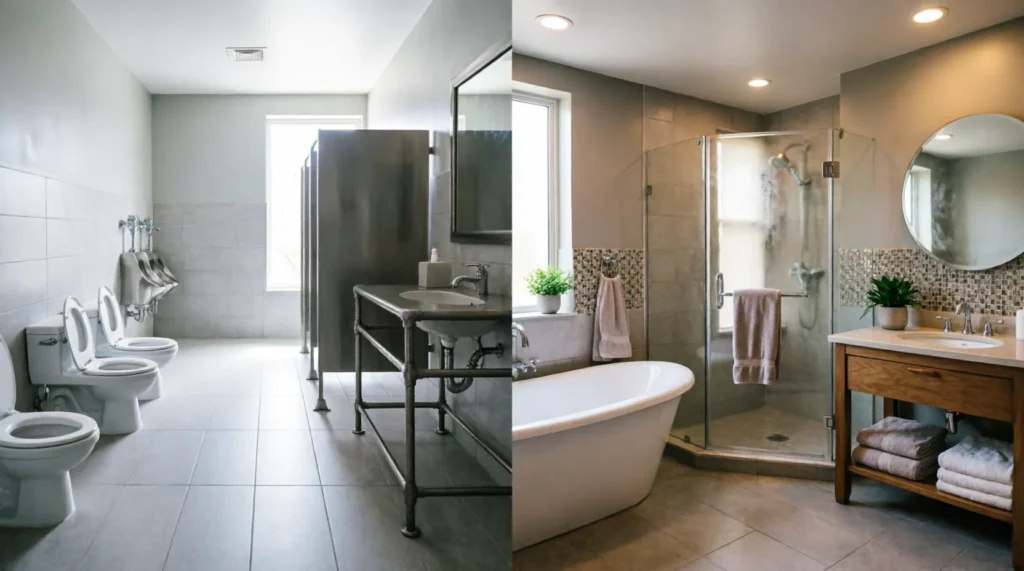
Quick answer: The difference between restroom and bathroom is primarily regional and contextual. In American English, “bathroom” refers to a room with a toilet and bathing facilities in a home, while “restroom” is the polite public term for a facility with toilets but no bathing amenities. In British English, “toilet” or “loo” is standard for both contexts, and “bathroom” strictly implies a bath or shower is present.
These two terms cause confusion because they are often used interchangeably in casual conversation, yet they carry distinct social and architectural implications. Using the wrong term can signal that you are unfamiliar with local etiquette or architectural norms. Understanding the nuance ensures you communicate clearly whether you are designing a building, writing signage, or simply asking for directions in a foreign country.
| Term | Meaning / When to use | Example sentence |
|---|---|---|
| Bathroom | A private room in a residence containing a toilet, sink, and bathing facility (bathtub or shower). | “I need to freshen up in the bathroom before the guests arrive.” |
| Restroom | A public facility containing toilets and sinks, but typically no bathing facilities; used as a polite euphemism in North America. | “Excuse me, could you tell me where the nearest restroom is?” |
When to use Bathroom
In American English, the word “bathroom” is deeply rooted in domestic architecture. Historically, rooms containing toilets were separate from rooms containing baths. As indoor plumbing became standard in the 20th century, these functions merged into a single room in most homes. Consequently, Americans began using “bathroom” as the default term for any room with a toilet, regardless of whether a bath was present.
However, strict usage dictates that “bathroom” should be reserved for private residential settings or spaces where bathing is a primary function. If you are in someone’s home, a hotel suite, or a gym locker room, “bathroom” is the correct and natural choice. It implies a level of privacy and personal care that extends beyond mere elimination.
Consider these real-world examples where “bathroom” is the appropriate choice:
- In a home setting: “Please take off your shoes before entering the bathroom; I just cleaned the tiles.”
- In a hotel context: “The master suite features a spacious bathroom with a jacuzzi tub and double vanities.”
- In a personal message: “I’ll be five minutes late; I’m stuck in the bathroom fixing my hair for the interview.”
Using “bathroom” in a public commercial space, such as a gas station or a restaurant, is common in casual American speech but can sound slightly informal or childish to some ears. It suggests a familiarity with the space that doesn’t exist in public venues. While you will not be misunderstood if you ask for the “bathroom” at a mall, it signals that you are applying domestic terminology to a public utility.
When to use Restroom
The term “restroom” emerged in the early 20th century as a euphemism. Architects and business owners wanted a more refined term for public toilets, which were often associated with poor hygiene and unpleasant odors. By calling them “restrooms,” they implied a place where one could “rest” or refresh oneself, elevating the perception of the facility. This term is almost exclusively used in North America for public facilities.
According to Wikipedia, the term “restroom” is commonly used in the United States and Canada to refer to public toilets, particularly in commercial establishments like restaurants, theaters, and office buildings. It is rarely used in residential contexts. You would never label a room in your own house as a “restroom” on a floor plan; it would sound clinical and distant.
Use “restroom” when you are in a public or semi-public space where the primary function is waste elimination and handwashing, not bathing. It is the standard term for signage, official documents, and polite inquiries in public settings.
Here are examples where “restroom” is the correct and expected term:
- In a restaurant: “Excuse me, waiter, may I use the restroom?”
- In an office building: “The restrooms on the third floor are currently under maintenance.”
- On architectural plans: “Public restroom access must comply with ADA accessibility guidelines.”
In British English, the term “restroom” is virtually unknown. If you use it in London, people may look at you quizzically, assuming you mean a lounge area where one can sit and rest. In the UK, Australia, and New Zealand, the preferred terms are “toilet,” “loo,” or “WC” (water closet). Therefore, “restroom” is a distinctly North American cultural marker.
How to remember the difference
The easiest way to remember the distinction is to focus on the prefix and the setting. “Bath” implies water, soap, and cleaning your entire body. You do this in private. “Rest” implies a pause in your activity, a brief break from shopping, dining, or working. You do this in public.
Try this mnemonic: If you can bathe, it’s a bathroom. If you can only rest, it’s a restroom. For more, see Difference.
Another helpful trick is to think about the furniture. A bathroom has a bathtub or shower stall. A restroom has stalls and urinals. If there is no tub, it is technically not a bathroom, even if Americans call it one out of habit. However, in public spaces, always default to “restroom” to sound polished and aware of social norms.
For editors and writers, consider the tone of the document. If you are writing a novel set in a suburban American home, characters will say “bathroom.” If you are writing a travel guide for New York City, you should advise tourists to look for “restrooms.” Context dictates correctness.
Common mistakes and exceptions
One of the most frequent mistakes is using “restroom” in a residential context. Saying, “I’m going to the restroom,” when you are in your own home sounds overly formal and strange to native American ears. It creates emotional distance, as if you are a guest in your own house. Conversely, using “bathroom” in a high-end European hotel might confuse staff who distinguish strictly between a “WC” (toilet only) and a “bathroom” (with a tub).
Another common error is assuming the terms are interchangeable globally. In many parts of Europe and Asia, direct terms like “toilet” are not considered rude. In fact, using euphemisms like “restroom” or “powder room” can be seen as evasive or confusing. Clarity is valued over politeness in many cultures. For instance, in Japan, signs clearly say “Toilet” in English, and using this term is perfectly acceptable.
There are also architectural exceptions. Some modern public facilities, such as those in gyms, spas, or luxury hotels, do contain showers and bathing areas. In these cases, the term “bathroom” or “shower room” might be more accurate, but “restroom” is still often used for the toilet-only section. It is essential to look at the specific amenities. If a public facility includes a shower, it may be labeled as a “changing room” or “locker room” rather than a restroom.
In professional writing, consistency is key. Do not switch between “bathroom,” “restroom,” “lavatory,” and “toilet” in the same document unless you are specifically distinguishing between them. Choose the term that best fits your audience. For a general American audience, “restroom” is safest for public contexts. For a British audience, “toilet” is the clear winner.
Frequently Asked Questions
Is it rude to say “toilet” in the United States? It is not necessarily rude, but it is considered blunt and less polite than “restroom.” In casual conversation among friends, “toilet” is acceptable, but in formal settings or when speaking to strangers, “restroom” is the preferred euphemism.
Why do Americans call it a bathroom if there is no bath? This is a linguistic holdover from the mid-20th century when home toilets and baths were combined into one room. The term “bathroom” became the generic word for any room with a toilet in a house, and this usage bled into public speech, though “restroom” remains the standard for public facilities.
What is the correct term to use in a business email? If you are referring to a facility in your office building, use “restroom.” For example, “The restrooms on the second floor are being renovated.” If you are writing to a British colleague, use “toilet” or “WC” to avoid confusion.
Can I use “lavatory” instead of restroom? “Lavatory” is technically correct but sounds extremely formal and archaic. It is mostly used in aviation (airplane lavatories) or in very old-fashioned literature. In modern everyday English, it is best to stick with “restroom” for public spaces and “bathroom” for private ones.

Thomas Anderson holds a master’s degree in Linguistics from the University of Cambridge and has over 15 years of experience exploring the intricacies of the English language. His fascination with etymology and word usage began in his teenage years, prompting him to pursue a career that combined his love for words with his analytical skills. As an expert in semantic nuances, Thomas is particularly adept at dissecting the subtle distinctions between synonyms and homonyms. His work at WordChoiceHub focuses on providing clear, concise comparisons that empower readers to choose the right word with confidence. He has an exceptional ability to make complex linguistic concepts accessible to a broad audience, whether they’re language enthusiasts, students, or professionals seeking to improve their communication skills. His content often explores the historical evolution of English vocabulary, offering insights into why certain word choices are preferred in different contexts. Thomas is passionate about fostering a deeper appreciation for the richness of the English language and delights in guiding others on their journey of discovery.